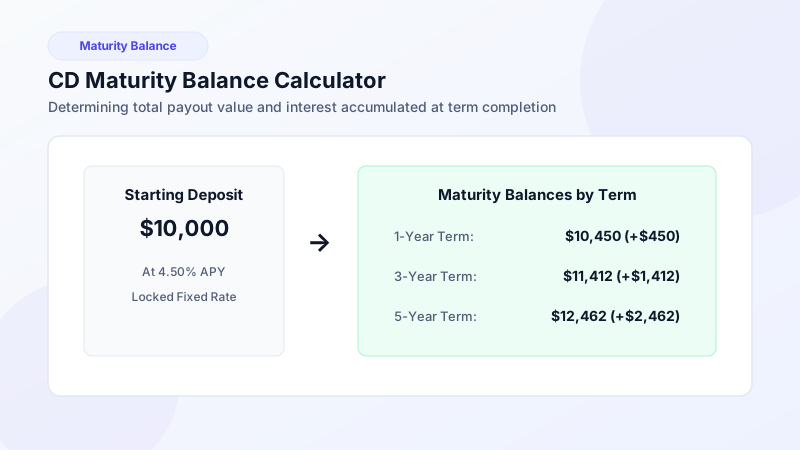
CD Maturity Calculator: How to Calculate Your Balance When the CD Term Ends
Calculate your exact certificate of deposit maturity balance with compound interest formulas and evaluate renewal and reinvestment options.
Estimate the interest earned and final balance on a certificate of deposit. Enter your deposit amount, APY, term length, and compounding frequency to see projected earnings.
A CD calculator is a financial tool that computes the total interest earned and final balance on a certificate of deposit (CD). The calculator uses compound interest math to show how an initial deposit grows over a fixed time period at a given annual percentage yield (APY).
The CD calculator uses the standard compound interest formula to compute the final balance. Each variable in the formula controls a specific part of how interest accumulates over the term of the certificate of deposit.
Click or tap any variable to see what it means
The effective annual yield (EAY) increases with more frequent compounding. A $10,000 CD at 5% APY compounded daily earns $2.09 more per year than the same CD compounded annually.
Calculate your certificate of deposit earnings in 3 steps. The calculator instantly shows your projected interest earned, final balance, and a growth chart the moment you click Calculate.
Type your initial deposit amount in dollars and the annual percentage yield (APY) offered by your bank or credit union. The APY already accounts for compounding, so enter the exact rate from your CD offer.
Choose the CD term length in months or years. Then select the compounding frequency — daily (365 times per year), monthly (12 times per year), quarterly (4 times per year), or annually (1 time per year).
Click Calculate to see the total interest earned in dollars, the final balance at maturity, and a visual growth chart. Adjust any input to compare different CD scenarios side by side.
Five main factors determine how much interest a certificate of deposit earns. Understanding each factor helps you pick the CD that produces the highest return for your situation.
A higher APY means more interest earned on the same deposit. Even a 0.25% difference on a $10,000 deposit adds $25 per year in additional interest.
Daily compounding earns more than monthly compounding, which earns more than quarterly or annual compounding. The difference grows larger on bigger deposits and longer terms.
Longer CD terms of 3 to 5 years typically offer higher APY rates than shorter 6-month or 1-year terms. The trade-off is reduced access to your funds until the maturity date.
Larger deposits generate more total interest in dollar terms. A jumbo CD (typically $100,000 or more) may qualify for a higher APY at some banks and credit unions.
Withdrawing funds before the maturity date triggers a penalty, usually equal to 3 to 12 months of interest. No-penalty CDs exist but typically offer a lower APY.
Interest earned after 5 years by compounding frequency
See exactly how much interest a certificate of deposit earns at current rates. These 4 examples use real compound interest math at monthly compounding to show projected returns on common deposit amounts.
10 specialized certificate of deposit calculators designed for precision yield forecasting, compounding comparisons, and custom investment terms.
Compute the exact dollar amount of interest a CD earns at any rate, term, and compounding frequency.
Project the total value of your CD on its maturity date and plan renewals or withdrawals.
Convert a stated APR into the effective APY based on compounding frequency to compare CD offers.
See how compound interest accelerates CD growth and compare daily, monthly, and quarterly schedules.
Calculate returns using the simple interest formula I = P × r × t and compare to compound alternatives.
Calculate CD returns with 365 compounding events per year — the highest-yield standard schedule.
Estimate CD earnings with monthly compounding — the industry-standard schedule at most banks.
Calculate CD interest with quarterly compounding — 4 interest calculations per year.
Enter an exact day count — 30, 90, 180, or any custom number — to get penny-precise CD returns.
Break down CD earnings into monthly intervals to track interest growth month by month.
CD interest is calculated using the compound interest formula A = P × (1 + r/n)^(n×t), where P is your deposit, r is the annual rate, n is compounding frequency, and t is the term in years.
A $10,000 CD at 5.00% APY compounded monthly earns about $512 in one year and roughly $2,834 over five years.
A $100,000 CD at 5.00% APY compounded monthly earns about $5,116 in one year and roughly $28,336 over five years.
Most CDs are compounded either daily or monthly — daily compounding earns slightly more since interest begins generating its own interest sooner.
Expert insights, compounding tutorials, and practical strategies to help you maximize your certificate of deposit returns.
Calculate your exact certificate of deposit maturity balance with compound interest formulas and evaluate renewal and reinvestment options.
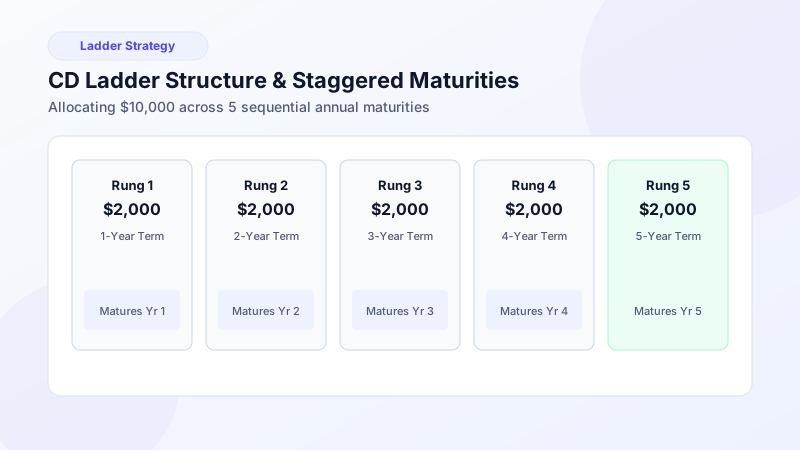
Discover how to build a CD ladder with staggered maturity dates to capture high long term rates while maintaining regular annual cash liquidity.
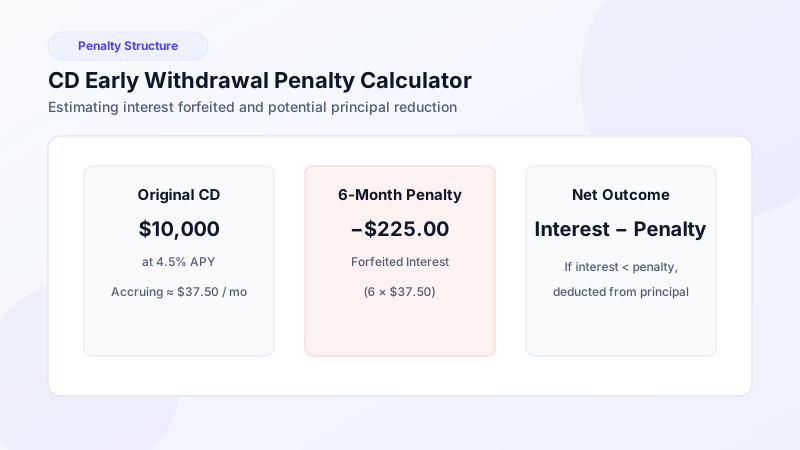
Learn how banks calculate CD early withdrawal penalties, how many months of interest you forfeit, and when penalties reduce your principal deposit.