CD Maturity Calculator: How to Calculate Your Balance When the CD Term Ends
Knowing your CD’s exact balance at the end of its term helps you plan ahead, whether you’re counting on those funds for a specific goal or deciding what to do next. This guide walks through calculating your expected maturity value step by step.
What CD Maturity Means for Your Account
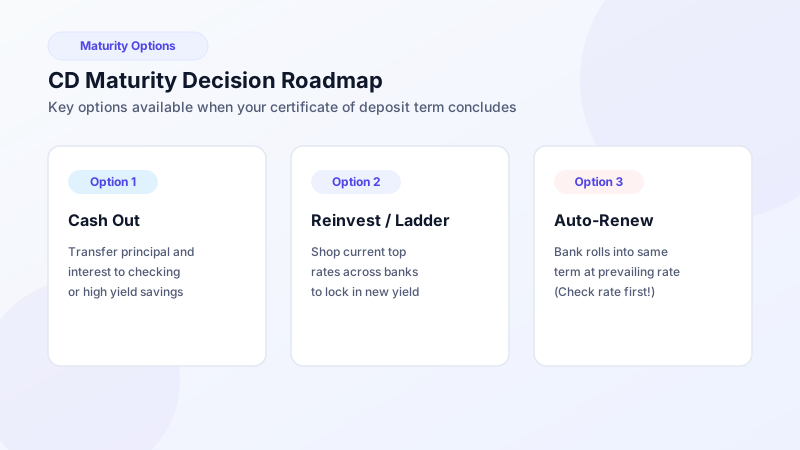
CD maturity refers to the point when your certificate of deposit’s fixed term officially ends. At this moment, your original principal plus all accumulated interest becomes available, and the bank typically requires you to decide what happens next, whether that’s withdrawing the funds, reinvesting them, or letting the CD automatically renew.
How to Calculate the Balance You Should Have at Maturity
The core formula for calculating your maturity value is: Final Balance = Principal × (1 + rate/n)^(n×t), where “n” represents compounding periods per year and “t” represents the term in years. This same compound interest formula applies whether you’re calculating a six-month CD or a five-year CD.
How the Starting Deposit Affects the Final Amount
Your principal scales the final result proportionally. A $20,000 deposit will produce exactly double the interest earnings of a $10,000 deposit at an identical rate and term, since the formula applies the same percentage growth to whatever starting amount you enter.
How the CD Rate Contributes to Maturity Value
The interest rate, or ideally the APY, drives the pace of growth toward your final balance. Higher rates produce a larger maturity value for any given principal and term combination, with the gap between rate options widening further as the term length increases.
How APY and Compounding Influence the Ending Balance
If your bank quotes APY rather than a nominal rate, the compounding effect is already built into that figure, simplifying your calculation to a single multiplication for one-year terms. For multi-year terms, you’d still need to apply the full compound interest formula, using the APY as your rate input.
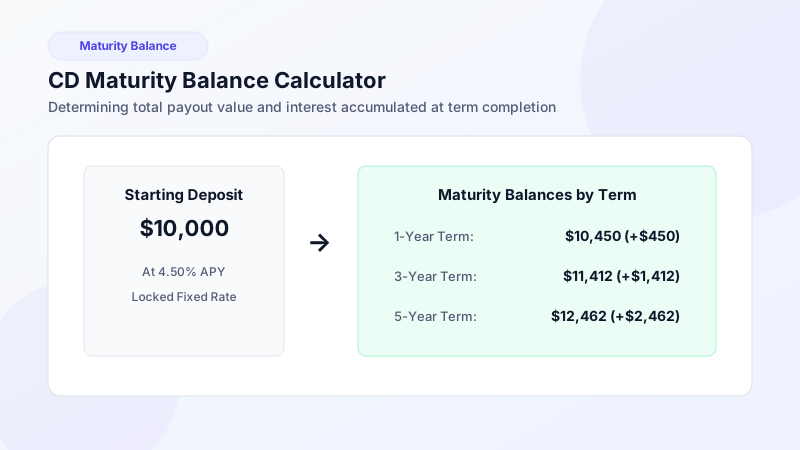
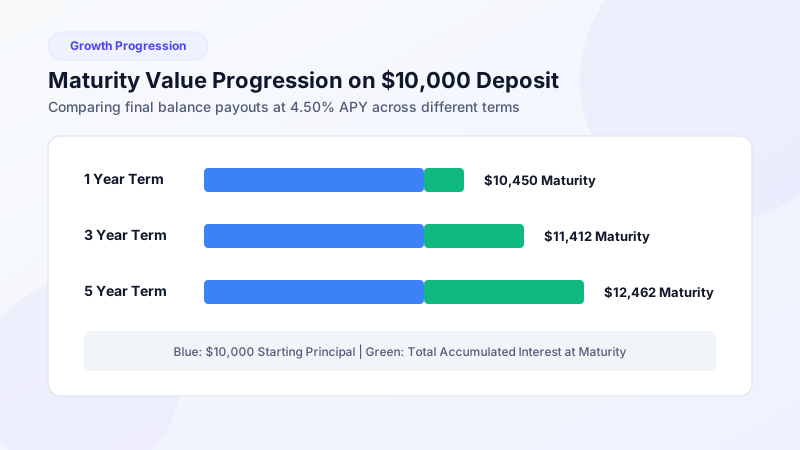
| Deposit | Rate | Term | Approximate Maturity Value |
|---|---|---|---|
| $10,000 | 4.5% APY | 1 year | $10,450 |
| $10,000 | 4.5% APY | 3 years | $11,412 |
| $10,000 | 4.5% APY | 5 years | $12,462 |
What Happens When Interest Is Paid Into the CD
Most CDs reinvest earned interest directly back into the account balance, allowing compounding to work throughout the term. Some CDs instead offer periodic interest payouts to a separate account, in which case your principal stays flat and the compounding effect doesn’t apply the same way.
How to Calculate Maturity for Different CD Terms
Adjust the “t” variable in the compound interest formula to match your specific term. A three-month CD would use t = 0.25, a one-year CD uses t = 1, and a five-year CD uses t = 5. Everything else in the formula stays the same regardless of term length.
What Happens When the CD Automatically Renews
Many banks automatically roll a matured CD into a new CD of the same term length unless you instruct otherwise, often called automatic renewal. The new CD typically opens at whatever the bank’s current rate is for that term, which could be higher or lower than your original rate. Reviewing your CD’s renewal terms before maturity helps avoid an unwanted automatic rollover at an unfavorable rate.
How to Compare Your Expected Balance With the Bank’s Maturity Disclosure
Banks generally provide a maturity disclosure statement showing the exact expected balance at account opening. Compare this figure against your own calculation as a sanity check. A close match confirms your understanding of the CD’s terms, while a significant mismatch suggests double-checking your assumed rate or compounding frequency.
Conclusion: Calculating Your CD Balance at Maturity
Calculating your CD’s maturity value comes down to the same core variables covered throughout this guide: principal, rate, term, and compounding frequency. With the compound interest formula in hand, or simply using APY for a quicker estimate, you can confidently predict your ending balance and plan ahead for whatever comes after your CD matures. This article provides general educational information and is not personalized financial advice.
Ready to Calculate Your CD Returns?
Use our free CD Calculator to model your deposit, APY, and interest compounding instantly.
Try the CD Calculator