How to Calculate CD Interest
Certificates of deposit remain one of the most predictable ways to grow savings, but understanding exactly how much a CD will earn requires more than glancing at an advertised rate. This guide walks through every variable that shapes your final balance, from the initial principal to the compounding schedule, so you can calculate your own numbers with confidence instead of guessing.
What Information Do You Need Before Calculating CD Interest?
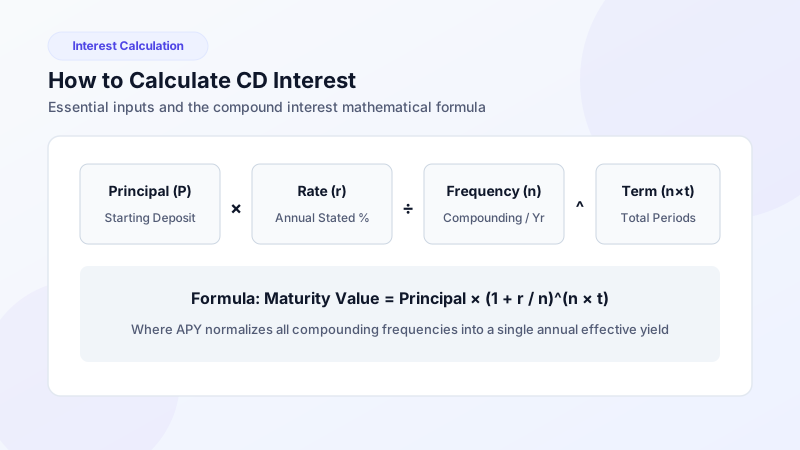
Before running any CD interest calculation, gather four essential pieces of information. You need the principal amount you’re depositing, the stated interest rate or APY, the term length in months or years, and the compounding frequency the bank uses. Missing any one of these turns your estimate into a rough guess rather than an accurate projection.
Most banks disclose all four figures clearly on their CD product pages or disclosure statements. If a bank doesn’t specify compounding frequency, it’s worth calling and asking directly, since this detail meaningfully changes your final maturity value.
How the Principal Amount Affects Your Total CD Earnings
Your principal is the foundation of every calculation. Interest earnings scale directly with this starting deposit, so doubling your principal roughly doubles your CD earnings at any given rate and term. A $5,000 deposit and a $10,000 deposit at identical terms will produce proportionally identical percentage returns, just different dollar amounts.
This linear relationship makes it easy to scale examples. If you know what $1,000 earns at a given rate, you can multiply that result by however many thousands you’re actually depositing to estimate your own CD return.
How the Interest Rate Changes the Amount You Earn
The interest rate determines how quickly your principal grows. Even small rate differences compound into meaningful gaps over time, especially with longer terms or larger deposits. A CD offering 4% will always underperform one offering 5%, assuming identical terms and compounding, though the actual dollar difference depends heavily on your deposit size.
Banks often advertise their most competitive rates for longer terms or larger minimum deposits, so comparing rates fairly means checking that you’re looking at the same term length across different offers.
How the CD Term Determines Your Interest Growth
Longer terms generally allow more time for interest to accumulate, producing higher total earnings even at identical rates. A one-year CD and a five-year CD at the same rate will produce very different total dollar amounts, since the five-year version has far more time for compounding to work.
| Term Length | Effect on Total Earnings |
|---|---|
| Short (3-6 months) | Lower total interest, faster access |
| Medium (1-2 years) | Moderate growth, balanced flexibility |
| Long (3-5+ years) | Higher total interest, longer lock-up |
Keep in mind that longer terms typically come with stricter early withdrawal penalty terms, so the extra earnings potential trades off against reduced liquidity.
How Compounding Frequency Affects the Final Balance
Compounding frequency describes how often earned interest gets added back to your principal, after which future interest calculates on the new, larger balance. Common frequencies include daily, monthly, quarterly, and annual compounding. More frequent compounding produces marginally higher returns, since interest starts earning its own interest sooner.
The difference between daily and monthly compounding is usually small for typical CD terms and rates, often amounting to just a few dollars on a modest deposit. Still, every bit matters when comparing otherwise similar offers.
How to Calculate Simple CD Interest With a Basic Example
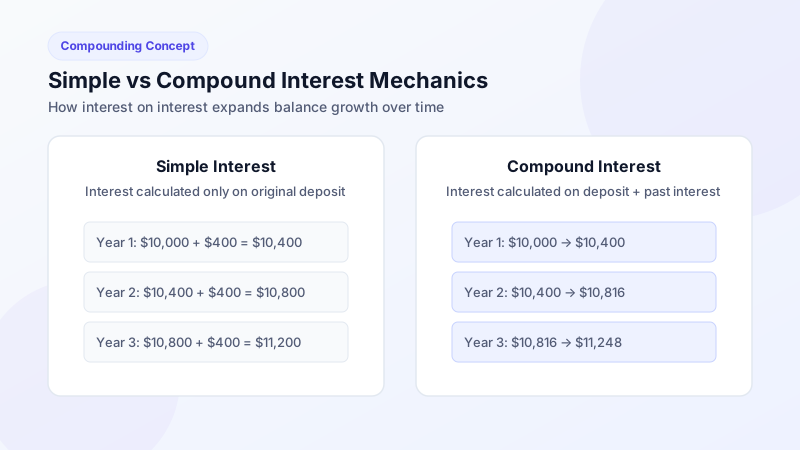
Simple interest, though rarely used for actual bank CDs, provides a useful starting point for understanding the mechanics. The formula is straightforward: multiply the principal by the rate, then multiply by the time period in years.
For example, a $10,000 deposit at a 4% simple annual rate for one year earns exactly $400 in interest. This calculation ignores compounding entirely, treating interest as a flat, one-time addition based purely on the original principal.
How to Calculate Compound CD Interest Step by Step
Real-world CDs almost always use compound interest. The standard formula is: Final Balance = Principal × (1 + rate/n)^(n×t), where “n” represents the number of compounding periods per year and “t” represents the term in years.
Consider a $10,000 CD at 4% compounded monthly over one year. Here, n equals 12 and t equals 1. The monthly rate becomes 4% divided by 12, or roughly 0.333%. After running this through the formula across twelve compounding periods, the ending balance lands just above $10,407, meaning compounding added a few extra dollars compared to the simple interest example above.
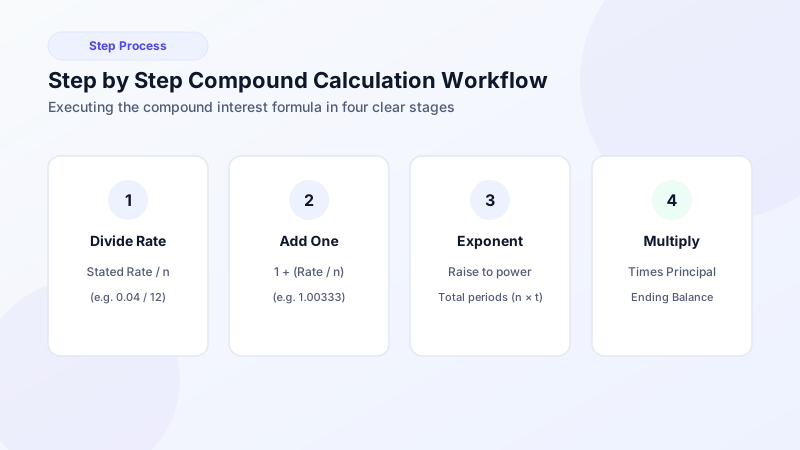
Step-by-step breakdown:
- Divide the annual rate by the compounding frequency
- Add 1 to that decimal figure
- Raise the result to the power of total compounding periods
- Multiply by your original principal
How APY Can Simplify the Interest Calculation
APY, or annual percentage yield, already factors in compounding, making calculations considerably easier. Rather than working through the full compound interest formula, you simply multiply your principal by the APY percentage to estimate one year of earnings.
| Input | Calculation Effort |
|---|---|
| Nominal rate + compounding frequency | Requires full formula |
| APY | Simple multiplication |
This is precisely why banks often advertise APY prominently. It gives depositors a straightforward, apples-to-apples way to compare products without manually calculating compounding effects.
How to Check Your Result Against a CD Calculator
After running your own numbers, cross-check the result using an online CD calculator. These tools apply the same underlying formulas but eliminate manual calculation errors. If your hand-calculated figure closely matches the calculator’s output, you can trust your understanding of the math. Any large discrepancy usually points to a mismatched compounding frequency or rate assumption.
Many bank websites also display the exact maturity value directly during account opening, which offers a final, authoritative confirmation of what you should expect to see at term’s end.
Conclusion: How to Calculate CD Interest Correctly
Calculating CD interest accurately comes down to knowing four key inputs: principal, rate, term, and compounding frequency. Whether you rely on the compound interest formula directly or lean on the simplified APY figure, understanding these mechanics helps you compare offers intelligently and set realistic expectations for your certificate of deposit earnings. This article is educational information, not personalized financial advice; actual returns depend on your specific bank’s terms and current rates.
Ready to Calculate Your CD Returns?
Use our free CD Calculator to model your deposit, APY, and interest compounding instantly.
Try the CD Calculator