How Much Does a $10,000 CD Earn at 4%, 4.5%, and 5%?
A round number like $10,000 makes for an easy, relatable example when comparing CD rates. This guide walks through exactly how much interest a $10,000 deposit generates at three common rate points, so you can see the real dollar impact of even small rate differences.
What a $10,000 Deposit Looks Like at Different Rates
Starting with a clean principal of $10,000 removes guesswork from comparing rates directly. Every calculation below assumes this same starting deposit, letting the interest rate itself be the only variable that changes between examples.
These figures use annual compounding for simplicity in the base examples, with a note further below on how more frequent compounding shifts the results slightly higher.
How Much Interest $10,000 Can Generate at 4%
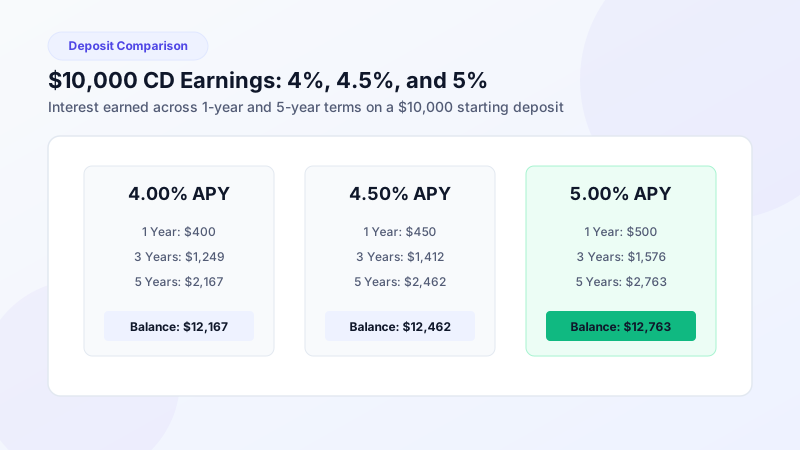
At a 4% annual rate, a $10,000 CD earns approximately $400 over one year, assuming simple annual compounding. Over a five-year term at the same rate, compounding annually, the balance grows to roughly $12,167, representing about $2,167 in total interest earned across the full term.
| Term | Approximate Balance at 4% |
|---|---|
| 1 year | $10,400 |
| 3 years | $11,249 |
| 5 years | $12,167 |
What Changes When the Rate Increases to 4.5%
Bumping the rate to 4.5% increases one-year earnings to approximately $450, fifty dollars more than the 4% example. Over five years, the balance grows to roughly $12,462, about $295 more than the equivalent 4% CD over the same period.
| Term | Approximate Balance at 4.5% |
|---|---|
| 1 year | $10,450 |
| 3 years | $11,412 |
| 5 years | $12,462 |
How a 5% CD Compares With the Lower Rates
At 5%, one year of interest on $10,000 comes to approximately $500. Over five years, the balance reaches roughly $12,763, representing $2,763 in total earnings, nearly $600 more than the 4% scenario over the identical term length.
| Rate | 1-Year Interest | 5-Year Interest |
|---|---|---|
| 4% | $400 | $2,167 |
| 4.5% | $450 | $2,462 |
| 5% | $500 | $2,763 |
How the CD Term Changes Total Earnings
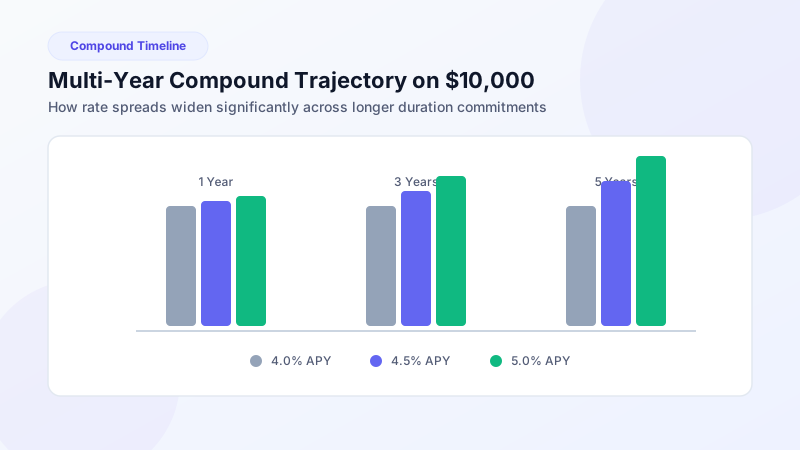
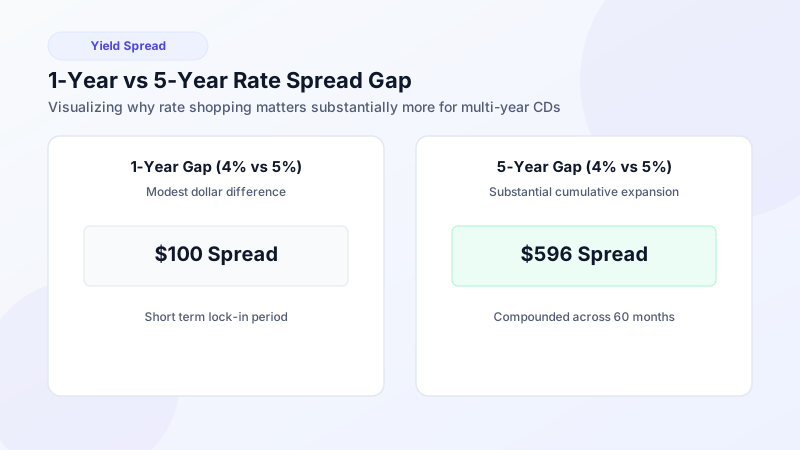
The gap between rates widens considerably as the term lengthens. Over just one year, the difference between 4% and 5% amounts to only $100. Stretch that same comparison to five years, and the gap grows to nearly $600, illustrating how rate differences compound into much larger dollar amounts over longer holding periods.
Why APY Matters When Comparing the Three Rates
These examples assume the stated rate already reflects APY, meaning compounding effects are baked in. If instead you’re comparing nominal rates with different compounding frequencies, the actual dollar outcomes could shift slightly from the figures shown here. Always confirm whether an advertised rate is APY or a nominal rate before running your own comparison.
How Compounding Can Affect the Final Balance
More frequent compounding, such as monthly or daily instead of annual, nudges these results marginally higher. For a $10,000 deposit at 5% compounded monthly rather than annually over one year, the ending balance increases by a small amount, typically just a few dollars, since more frequent compounding allows interest to earn interest sooner within the year.
How Taxes Can Reduce the Amount You Keep
Remember that CD interest counts as taxable income in most cases. On the $500 earned in the 5% one-year example, a saver in a 22% tax bracket would keep roughly $390 after federal taxes alone, before considering any applicable state tax. Factor this reduction into your expectations if you’re planning around a specific after-tax target.
How to Scale the Example to Other Deposit Amounts
Because interest earnings scale proportionally with principal, you can easily adjust these figures for a different deposit size. A $20,000 deposit at any of these rates simply doubles the dollar figures shown above, while a $5,000 deposit cuts them exactly in half.
Conclusion: Comparing CD Earnings on a $10,000 Deposit
Even a half-percentage-point difference in rate produces a meaningful gap in earnings once you factor in longer terms and compounding. Comparing 4%, 4.5%, and 5% on an identical $10,000 deposit makes clear why shopping around for the best available rate is worth the extra effort, especially for longer-term commitments. This article uses illustrative examples for educational purposes and does not constitute financial advice; actual rates and terms vary by institution.
Ready to Calculate Your CD Returns?
Use our free CD Calculator to model your deposit, APY, and interest compounding instantly.
Try the CD Calculator