How Do You Calculate Interest on a CD

Many savers open a certificate of deposit without fully understanding how the advertised number translates into actual dollars earned. This guide breaks down exactly what CD interest represents and walks through the practical steps for calculating your own returns, whether you’re planning a short-term deposit or a multi-year commitment.
What Does CD Interest Actually Represent?
CD interest is the compensation a bank pays you for locking up your money for a fixed term. Unlike a regular savings account, where the rate can change anytime, a CD’s rate typically stays fixed for the entire duration you agree to. This predictability is part of what makes CDs attractive for savers who want a guaranteed outcome rather than market-linked uncertainty.
The interest itself gets calculated based on your deposit amount, the agreed rate, and how frequently that interest compounds back into your balance throughout the term.
How Your Initial Deposit Enters the Calculation
Your principal, the initial deposit, serves as the base figure every calculation builds from. Banks apply the interest rate directly to this amount, and as compounding occurs, they apply subsequent calculations to the growing balance rather than the original figure alone.
A larger initial deposit produces proportionally larger dollar earnings at any given rate, though the percentage return itself stays identical regardless of deposit size.
How the Advertised Rate Relates to Your Earnings
Banks typically advertise both a nominal interest rate and an APY. The nominal rate reflects the base percentage before accounting for compounding, while APY reflects your true annual return once compounding effects are included. For calculation purposes, APY is usually the more useful figure since it already bakes in the compounding math.
| Rate Type | What It Shows |
|---|---|
| Nominal rate | Base percentage, pre-compounding |
| APY | True effective annual return |
Why the Length of the CD Matters
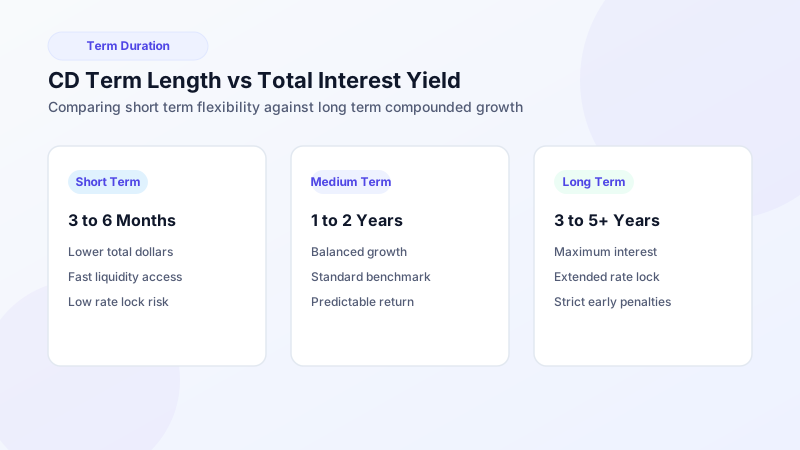
The CD’s term directly affects total earnings because it determines how long your money has to grow. A six-month CD generates roughly half the interest of a comparable one-year CD at the same rate, all else being equal, simply because there’s less time for growth to occur.
Longer terms usually come paired with higher rates too, since banks reward depositors for committing their funds for extended periods without access.
How APY Reflects the Effect of Compounding
APY exists specifically to capture the real-world impact of compounding frequency. Two CDs with identical nominal rates but different compounding schedules will show slightly different APY figures, with more frequent compounding producing a marginally higher APY.
This is why comparing raw nominal rates across banks can be misleading. Always compare APY figures instead, since they represent a standardized, apples-to-apples measure of actual annual return.
How to Estimate Interest on a Short-Term CD
For CDs under one year, calculate interest proportionally. Take the APY, multiply it by your principal, then multiply by the fraction of the year your CD covers. A six-month CD at 4.5% APY on a $5,000 deposit earns approximately $5,000 × 0.045 × 0.5, which comes to roughly $112.50.
This proportional approach works well for quick estimates, though the exact figure may differ slightly depending on the bank’s specific day-count conventions.
How to Calculate Earnings on a Long-Term CD
For multi-year CDs, compounding effects become more significant. Using the compound interest formula, Final Balance = Principal × (1 + rate/n)^(n×t), a $5,000 deposit at 4.5% compounded monthly over three years grows to approximately $5,720, representing about $720 in total interest earnings across the full term.
Quick reference for a $5,000 deposit at 4.5% APY:
| Term | Approximate Interest Earned |
|---|---|
| 1 year | $225 |
| 2 years | $460 |
| 3 years | $720 |
How Monthly Interest Payments Can Affect the Account Balance
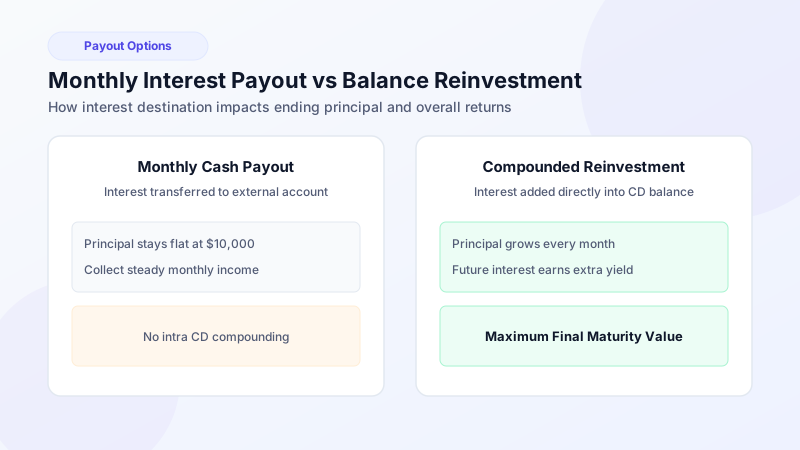
Some CDs offer monthly interest payouts rather than reinvesting earnings back into the account. If you choose to receive interest payments rather than let them compound, your ending principal stays flat throughout the term, and you simply collect steady monthly income instead of watching the balance grow.
This choice affects your total return calculation significantly, since interest that gets paid out rather than reinvested doesn’t generate additional interest of its own.
How to Verify a Bank’s Stated Maturity Amount
Once you’ve calculated your own estimate, compare it against the maturity figure your bank discloses at account opening. Banks are generally required to disclose the expected maturity value clearly. If your manual calculation and the bank’s figure differ significantly, double-check your assumed compounding frequency, since that’s the most common source of discrepancy.
Conclusion: Understanding How CD Interest Is Calculated
Calculating interest on a CD ultimately depends on four familiar variables: your deposit amount, the rate, the term, and how often interest compounds. Leaning on APY simplifies most calculations considerably, since it already reflects compounding effects. With these fundamentals in hand, you can confidently estimate what any CD offer will actually pay before you commit your funds. This is general educational content and not personalized financial advice.
Ready to Calculate Your CD Returns?
Use our free CD Calculator to model your deposit, APY, and interest compounding instantly.
Try the CD Calculator