CD APY vs APR Calculator: Which Rate Should You Enter?
Scrolling through CD offers, you’ll often see both APY and APR listed, sometimes for the same product. Knowing which figure to use in your own calculations, and why they sometimes differ, prevents costly misunderstandings about what a CD will actually pay.
What APY and APR Actually Measure
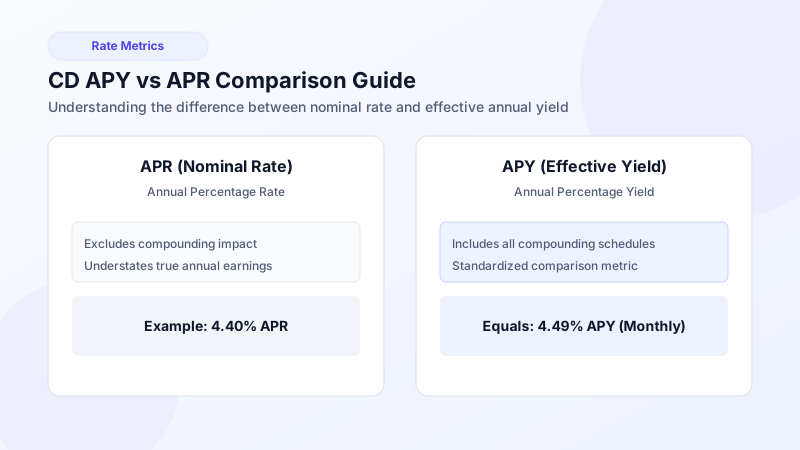
APY, annual percentage yield, reflects your true effective return over one year, including the impact of compounding. APR, annual percentage rate, represents a simpler, nominal rate that doesn’t account for compounding effects at all. For CDs specifically, APY is almost always the more relevant and commonly advertised figure.
Understanding this distinction prevents a common mistake: assuming a bank’s advertised percentage already includes compounding when it might not.
Why APY Usually Reflects Compounding
Because APY already incorporates how often interest compounds, it directly shows your realistic annual earnings. If a CD compounds monthly, the APY figure will be slightly higher than the nominal rate, since interest earns interest throughout the year.
This makes APY the single most useful number for comparing different CD products, regardless of how each bank structures its compounding schedule internally.
How APR Can Differ From the Effective Yield
APR doesn’t factor in compounding, so it consistently understates your actual return compared to APY whenever compounding occurs more than once annually. A CD advertised with a 4.4% APR might carry a 4.5% APY once monthly compounding gets factored in, a small but meaningful gap.
| Metric | Includes Compounding? | Typical Use |
|---|---|---|
| APR | No | Rarely primary figure for CDs |
| APY | Yes | Standard comparison metric |
Why CD Advertisements Commonly Highlight APY
Banks generally advertise APY because it’s the more favorable, higher-looking number, and because regulations often require standardized disclosure using this metric for deposit products. This benefits consumers too, since it creates a level playing field for comparing offers across different institutions.
How Compounding Frequency Changes the Relationship Between Rates
The gap between nominal rate and APY grows larger as compounding frequency increases. Daily compounding produces a slightly higher APY than monthly compounding at the same nominal rate, which itself produces a higher APY than annual compounding.
For typical CD rates in the 4-5% range, though, these differences tend to be modest, usually amounting to a fraction of a percentage point rather than a dramatic gap.
Which Rate a CD Calculator Needs for an Accurate Result
When using any CD calculator, always input APY rather than a nominal rate whenever possible. Using APY simplifies your calculation to a single multiplication step, since compounding effects are already baked into that figure. Using the nominal rate instead requires you to separately account for compounding frequency to get an accurate result.
How to Convert Between a Nominal Rate and an Effective Yield
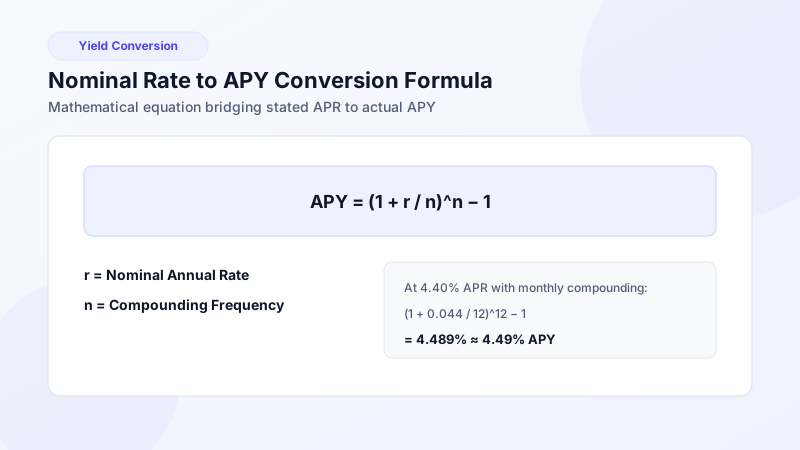
If you only have a nominal rate and compounding frequency, convert to APY using this formula: APY = (1 + nominal rate/n)^n - 1, where “n” is the number of compounding periods annually.
For example, a 4.4% nominal rate compounded monthly converts to: (1 + 0.044/12)^12 - 1, which works out to approximately 4.49% APY, illustrating how compounding nudges the effective return slightly higher than the stated nominal figure.
Why Two CDs With Similar Advertised Rates Can Produce Different Returns
Two CDs might show nearly identical headline rates yet produce different actual earnings if one compounds daily and another compounds only annually. Always compare the APY figures directly rather than the nominal rates, since APY normalizes these compounding differences into one comparable number.
How to Read a Bank’s CD Rate Disclosure
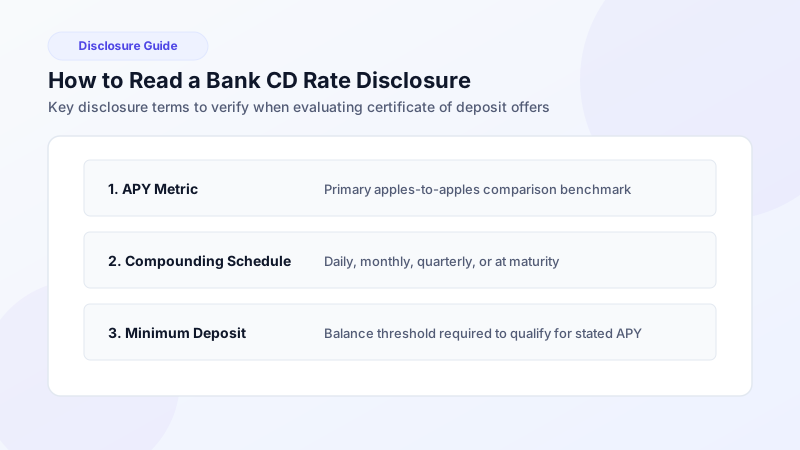
Most banks disclose both the nominal rate and APY clearly in their CD product documentation, often required by regulation. Look specifically for the APY figure when comparing offers, and confirm the compounding frequency listed alongside it, since this detail explains exactly how that APY was derived from the nominal rate.
| What to Check | Why It Matters |
|---|---|
| APY figure | Direct comparison across banks |
| Compounding frequency | Explains the APY calculation |
| Minimum deposit for that rate | Some rates require higher minimums |
Conclusion: Choosing APY or APR for a CD Calculation
For nearly every practical CD calculator scenario, APY is the number you want. It already reflects compounding, simplifies your math, and provides the most accurate basis for comparing different CD offers side by side. Reserve nominal rate and APR figures for situations where you need to manually reconstruct the compounding math yourself. This content is educational and doesn’t constitute financial advice.
Ready to Calculate Your CD Returns?
Use our free CD Calculator to model your deposit, APY, and interest compounding instantly.
Try the CD Calculator